
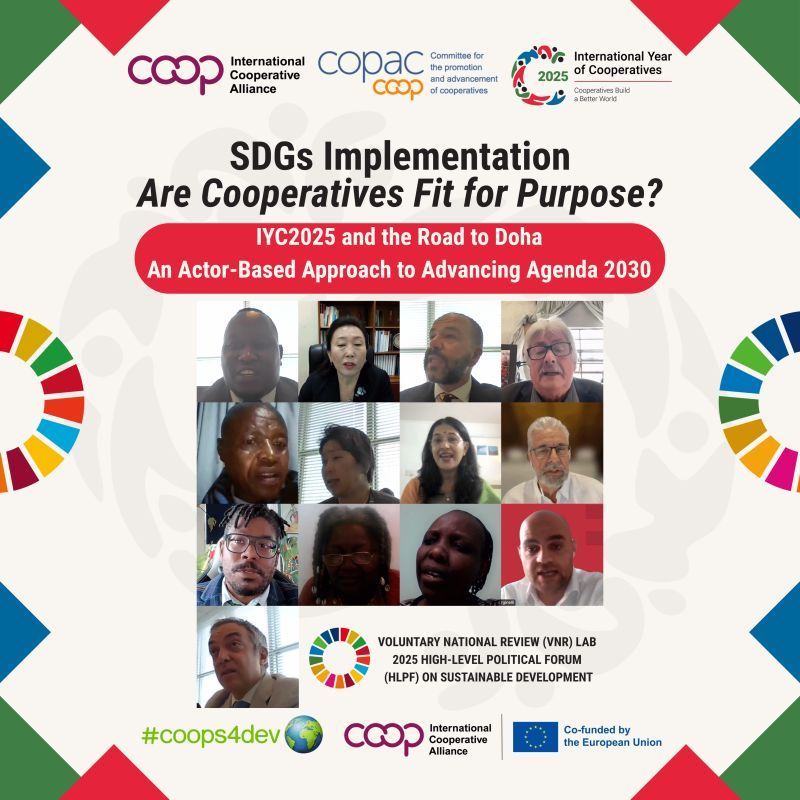
Are Cooperatives Fit for Purpose? VNR Lab held at HLPF 2025 in New York

As part of the 2025 High-Level Political Forum (HLPF) and the celebrations of the UN International Year of Cooperatives (IYC2025), the International Cooperative Alliance (ICA), in collaboration with the UN Committee for the Promotion and Advancement of Cooperatives (COPAC), hosted a Voluntary National Review (VNR) Lab at the UN Headquarters in New York on 15 July 2025. The session, titled “Are Cooperatives Fit for Purpose? IYC2025 and the Road to Doha”, brought together Member States, UN agencies, cooperative leaders, and development stakeholders to explore the role of cooperatives in advancing the Sustainable Development Goals (SDGs) and their engagement in national development and VNR processes.

The VNR Lab served as a strategic space to discuss how the cooperative model contributes to the SDGs, particularly in the context of national reporting and follow-up processes. It also aimed to build momentum toward the Second World Social Summit (WSS) to be held in Doha, Qatar, in November 2025, where the cooperative movement will present a global commitment plan to support the SDGs in the final stretch to 2030.

Opening and Framing the Dialogue

Opening the session, Mr Andrew Allimadi, Chair of COPAC and representative of the UN Department of Economic and Social Affairs (UNDESA), highlighted the timeliness of the event in light of IYC2025 and the forthcoming WSS, urging participants to recognise cooperatives not just as contributors to development but as key partners in shaping and implementing national SDGs agendas.

The keynote address was delivered by H.E. Ms Ulziibayar Vangansuren, Deputy Permanent Representative of Mongolia to the United Nations. Mongolia, one of the strongest advocates for cooperatives within the UN system, reaffirmed its longstanding commitment to cooperative development both nationally and globally. Ambassador Vangansuren presented Mongolia’s experience with initiatives such as the “New Cooperative – Wealthy Herder” programme, designed to support rural livelihoods, and emphasised the need to create enabling legal and policy frameworks for cooperatives. She reiterated Mongolia’s support for the inclusion of cooperatives in the Political Declaration of the World Social Summit and called on other Member States to support this advocacy.

Policy Dialogue: National Experiences in VNRs

The event, moderated by Joseph Njuguna, ICA Policy Director, featured an engaging policy dialogue with Member States who shared their experiences in integrating cooperatives into their VNRs: 

  • Japan (represented by Ms. Mariko Komatsu): Japan’s 2025 VNR included more than 60 references to cooperatives, demonstrating their integration across eight SDGs (Goals 1, 3, 5, 8, 11, 12, 13, and 17). Ms Komatsu highlighted the VNR consultation process and how various stakeholders, including representatives from cooperatives, were included in the process. The report further highlights initiatives such as community health watch systems operated by consumer co-ops, partnerships with over 1,300 municipalities, and strong legal support for cooperative development. Japan’s comprehensive approach stands out as a best practice model for other nations.
  • Chile (Mr Andrés Diaz, Permanent Mission of Chile to the UN): Noted cooperatives’ role in inclusive growth and the importance of government–cooperative partnerships in national planning and SDG 17 implementation.
  • Guatemala (Mr Helmer Herrera, INACOP): Shared how cooperatives were engaged in SDGs 5 and 17 via multi-stakeholder consultations. Emphasised gender equality and partnerships as central outcomes.
  • Lesotho (Mr Notsi Mokheseng, Cooperative Commissioner): Highlighted how cooperatives are aligned with all SDGs under review in Lesotho, particularly through their support to community-based economic activities and alignment with national development strategies.

Panel Discussion: Cooperatives in Action on Key SDGs under review

A technical panel showcased real-world examples of cooperative contributions to specific SDGs under review in 2025:

  • SDG 3 – Good Health and Well-being:
    Dr Carlos Zarco (International Health Cooperative Organisation, Spain) illustrated how health cooperatives are bridging service gaps, particularly in remote or underserved communities.
  • SDG 5 – Gender Equality:
    Dr Mallika Kumar (India) and Ms Pauline Effa (Cameroon) shared how cooperatives are empowering women through leadership opportunities, financial inclusion, and community organising.
  • SDG 8 – Decent Work and Economic Growth:
    Mr Esteban Kelly (U.S. Federation of Worker Cooperatives) presented the worker cooperative model as a proven strategy for job creation, income equality, and inclusive entrepreneurship.
  • SDG 14 – Life Below Water:
    Mr Gabriele Verginelli (Legacoop, Italy) discussed the role of fishery cooperatives in protecting marine ecosystems while securing livelihoods for small-scale fishers.
  • SDG 17 – Partnerships for the Goals:
    Dr Rose Karimi (ICA Africa) and Mr Danilo Salerno (ICA Americas) described the growing number of regional partnerships that foster South–South cooperation and proposed stronger integration of cooperatives in UN country frameworks and SDG financing platforms.

Japan’s 2025 VNR: A Model of Cooperative Integration

2025 Japan’s VNR Report emerged as a model for cooperative engagement, with over 60 references to cooperatives, systematically linking them to a wide range of SDGs, providing concrete examples of policy integration, partnership building, and impact monitoring. Its approach demonstrated how cooperatives are embedded into national and local SDG implementation strategies through partnerships with more than 1,300 municipalities and extensive citizen engagement. The VNR also highlighted measurable outcomes such as health monitoring by consumer cooperatives and the mobilisation of cooperative finance.

The Japanese government has not only recognised the scale and scope of its cooperative movement but also demonstrated how this sector can be mobilised to advance national development goals in a measurable and inclusive way. Japan also underscored its commitment to strengthening legal frameworks and is exploring the adoption of a Basic Law on the SDGs to institutionalize cross-sectoral alignment.

At the 2025 High-Level Political Forum (HLPF), 35 countries submitted their Voluntary National Review (VNR) reports, and cooperatives were recognised in 19 of these reports, a promising sign that their contributions are increasingly being acknowledged in national SDG implementation. However, this recognition remains partial as many VNRs still lack detailed strategies for supporting or scaling cooperative initiatives. Most notably, cooperatives are underrepresented in SDG planning, budgeting processes, and monitoring frameworks. This underscores the importance of advocacy to ensure that cooperatives are not only visible but are also actively involved in shaping development priorities at every level, given their important contribution to sustainable development.

Recommendations and Reflections

The session concluded with a number of strategic recommendations to enhance cooperative engagement in SDG implementation:

  • Governments are encouraged to formally include cooperatives in national SDG coordination mechanisms and policy frameworks.
  • Cooperatives are urged to proactively engage with relevant ministries, national development plans, and UN Country Teams.
  • Donor agencies and the UN system are called upon to recognize, support, and fund cooperative-led development initiatives.
  • Participants collectively advocated for explicit recognition of cooperatives in the Political Declaration of the World Social Summit, especially in relation to poverty eradication, decent work, gender equality, and social protection.

In her closing remarks, Ms Michelle Lau-Burke from the International Trade Centre (ITC) underscored the critical role of cooperatives as economic actors, service providers, and social anchors in times of crisis. She commended ICA and COPAC for creating a timely and inclusive dialogue platform and encouraged greater engagement between cooperatives and global development partners.

The ICA emphasised that with over 3 million cooperatives serving 1 billion members globally, the movement has the scale, experience, and values-based orientation necessary to advance the SDGs and build more resilient societies.

Looking Ahead to Doha

The VNR Lab served as a significant milestone during IYC2025, reinforcing the importance of cooperatives in the SDG ecosystem. It demonstrated that cooperatives not only support delivery of national development goals, but also provide scalable, inclusive, and community-driven solutions.

The ICA, together with COPAC and Member States, will host the official closing event of the International Year of Cooperatives at the World Social Summit in Doha. This event will launch a global commitment plan developed by the ICA and its Cooperative and Mutual 50 (CM50) leadership group, outlining the cooperative movement’s strategic contribution to the SDGs in the critical final years to 2030.

Member States and partners are warmly invited to join this event and collaborate with the cooperative movement to realise the promise of inclusive, sustainable, and people-centred development.

Special Accreditation Now Open for the Second World Summit for Social Development (WSSD2)

The Special Accreditation process for the Second World Summit for Social Development (WSSD2) is officially open!

Cooperatives and other organizations that are not accredited to ECOSOC must apply for Special Accreditation to participate in the Summit and its related events. Accreditation granted for other UN conferences does not transfer to WSSD2.

Key Information

Application period:
Monday, 28 April – Friday, 13 June 2025

Who must apply?
All cooperatives, social and solidarity economy (SSE) entities, civil society organizations, private sector companies, foundations, academia, and other stakeholders not already accredited to ECOSOC.

Who does NOT need to apply?

  • Member States
  • UN system organizations and specialized agencies
  • UN Secretariat
  • Organizations with ECOSOC consultative status
  • Intergovernmental organizations with observer status at the UN General Assembly

How to apply:
Visit the official summit website for detailed instructions and the application form:
👉 Second World Summit for Social Development 2025 | Division for Inclusive Social Development (DISD)

Required documents:

  1. A signed letter on official letterhead requesting accreditation
  2. Proof of the organization’s legal status (e.g., incorporation certificate)
  3. A report outlining relevant activities over the past 12 months

Applications will be reviewed by the United Nations Non-Governmental Liaison Service (UN-NGLS) and submitted for approval through the Office of the President of the General Assembly (OPGA). Organizations will be notified once the process concludes.

Please note: Special accreditation only allows organizations to access the registration process. Individuals must be associated with an accredited organization to attend, and separate participant registration will open later.


Why It Matters

The Second World Summit for Social Development will be a key milestone in advancing inclusive, sustainable societies. As we celebrate the International Year of Cooperatives 2025, it is crucial that cooperatives and SSE entities make their voices heard at the global level.

We encourage all eligible organizations to apply and share this information widely to ensure strong cooperative and SSE participation at WSSD2!


Need Assistance?

COPAC Launches “Building a Better World Together” SDG Brief Series Update for IYC2025

The Committee for the Promotion and Advancement of Cooperatives (COPAC) has launched a new series of Sustainable Development Goal (SDG) policy briefs under the theme Building a Better World Together, developed to mark the International Year of Cooperatives (IYC) 2025. Prepared by COPAC and the International Cooperative Alliance (ICA) under the #Coops4Dev partnership, with contributions from ICA regional offices and sectoral associations, the briefs highlight the essential role of cooperative enterprises in advancing sustainable development, strengthening resilience, and supporting inclusive growth worldwide. All COPAC members—including the Food and Agriculture Organization (FAO)International Labour Organization (ILO)United Nations Department of Economic and Social Affairs (UNDESA)United Nations Research Institute for Social Development (UNRISD)International Trade Centre (ITC), and International Cooperative Alliance (ICA)—are invited to provide feedback throughout the drafting process.

Building on the Transforming our World SDG brief series published between 2018 and 2020, the new briefs respond to the rapidly evolving global landscape and the urgent need to accelerate SDG implementation. Since the earlier series, global crises, including COVID-19, the intensifying climate emergency, and geopolitical and economic disruptions, have underscored the resilience and counter-cyclicality of cooperatives as sustainable, people-centered enterprises. The updated briefs provide renewed background context, present new case studies from across sectors and regions, and offer expanded recommendations for policymakers, cooperative networks, donors, and development partners to strengthen the role of cooperatives in advancing a just, inclusive, and sustainable recovery.

The first five briefs align with the SDGs under in-depth review at the 2025 High-Level Political Forum (HLPF):

Each brief highlights cooperative contributions to sustainable development, identifies structural barriers and emerging opportunities, and offers forward-looking recommendations to strengthen the enabling environment for cooperatives. Regional case studies illustrate innovative cooperative solutions delivering measurable impacts across diverse contexts.

The SDG brief series also supports preparations for the Second World Summit for Social Development (WSSD2), to be held in Doha in November 2025. WSSD2 will also feature the official closing of the International Year of Cooperatives 2025, providing a global platform to recognize cooperatives’ essential contributions to building more equitable, inclusive, and resilient societies. 

About COPAC

The Committee for the Promotion and Advancement of Cooperatives (COPAC) is a global multi-stakeholder partnership working to promote cooperatives as key contributors to sustainable development. COPAC members include the International Labour Organization (ILO), Food and Agriculture Organization (FAO), United Nations Department of Economic and Social Affairs (UNDESA), United Nations Research Institute for Social Development (UNRISD), International Trade Centre (ITC), and International Cooperative Alliance (ICA).

About the International Year of Cooperatives 2025

The International Year of Cooperatives 2025 (IYC 2025) was proclaimed by the United Nations General Assembly to highlight the contribution of cooperatives to achieving the Sustainable Development Goals and to encourage greater recognition and support for the cooperative model. Under the theme Cooperatives Build a Better World, IYC 2025 celebrates the impact of cooperatives in fostering inclusive, resilient, and sustainable societies.

COPAC Members Explore Institutional Pathways for Coop Growth & Resilience

As part of the ICA Global Conference held in New Delhi, India, the session on Institutional Support for Cooperative Development brought together leading experts from international organizations to discuss how policy, law, and institutional collaboration can create enabling environments for cooperatives. The panel was a key segment of the broader discussion on “Enabling Policy and Entrepreneurial Ecosystems,” a critical theme of the conference aimed at advancing cooperative resilience and growth in the face of global challenges. Moderated by Professor Hagen Henry, Chairperson of the ICA Cooperative Law Committee, it featured panelists representing major institutional actors and COPAC members: ILO, UN DESA, FAO, and ITC. The discussion focused on the role of institutional frameworks in fostering sustainable cooperative ecosystems and explored synergies between cooperative movements and international policy initiatives.

The session emphasized the importance of policy and legal frameworks, institutional collaboration, and practical mechanisms that ensure cooperatives thrive within entrepreneurial ecosystems. Discussions underscored the need for robust institutional support to enable cooperatives to respond to global challenges and contribute to inclusive, sustainable development.

Ms Wenyan Yang, Chief of the Social Perspective on Development Branch at UN DESA and Chair of The Committee for the Promotion and Advancement of Cooperatives (COPAC), provided insights on the UN’s role in advancing cooperatives, highlighting the 2023 UN Secretary-General’s report on cooperatives’ entrepreneurial ecosystems. She outlined four critical elements essential to cooperatives: Rules and regulations; Administrative services and infrastructure; Access to finance; and Business networks and markets.

Ms Yang emphasized how cooperatives can capitalize on the International Year of Cooperatives in 2025 by engaging in key processes throughout the year, such as the World Social Summit, the Commission for Social Development, and the High-Level Political Forum (HLPF).

“Our work at UN DESA and COPAC focuses on advocating for cooperatives within the UN system. We try to raise awareness and advocate for cooperative issues in the General Assembly and similar bodies, but to do so, we need a consolidation of evidence and empirical data.”

Ms Simel Esim, Manager of the ILO Cooperative, Social and Solidarity Economy (SSE) Unit, highlighted the organization’s long-standing support for cooperative development. She stressed the need for policy uptake and buy-in, urging a focus on implementation mechanisms and connecting established cooperative sectors with emerging ones, including those led by youth and women. Ms Esim also drew attention to the ILO’s 2022 International Labour Standards recommendation, adopted by over 120 countries, and the ongoing work to operationalize UN and ILO resolutions on the SSE.

Ms Cécile Berranger, Rural Institutions and Services Specialist at the FAO, spoke to the challenges smallholder farmers, women, and youth face due to climate change and economic marginalization. She emphasized the empowering role of cooperatives in building resilience and reducing inequalities. She called for capacity building at the grassroots level, referencing training tools like My.COOP for agricultural cooperative management, developed by the ILO and FAO in partnership with other institutions, alongside improved access to finance, education, and collaborative opportunities.

Dr Ashish Shah, Director of the Division of Country Programmes at the International Trade Centre (ITC), contextualized the panel within global crises – the 4Cs: COVID-19, climate change, the cost-of-living crisis, and conflict. He positioned cooperatives as a transformative solution, offering innovation, collaboration, and advocacy as pathways to sustainability and resilience. Dr. Shah highlighted the significance of the International Year of Cooperatives 2025 (IYC 2025) in driving these initiatives forward.

Panel Outcomes:

The session identified key areas for institutional collaboration and innovation, including:

  • The importance of aligning cooperative development strategies with broader policy goals like the SDGs and the IYC 2025.
  • Strengthening multi-stakeholder engagement and leveraging synergies between institutional actors, such as government agencies, international organizations, and cooperative movements.
  • Building capacity at all levels to ensure policies translate into tangible outcomes for cooperatives and their members.

Panelists collectively agreed on the need to reduce over-reliance on the state by harnessing broader ecosystems, including private sector actors and NGOs, to enhance resilience and mitigate political risks. This session was one of many with COPAC members’ participation throughout the week. For further updates follow COPAC on LinkedIn and X.

“Cooperatives Build a Better World” – Official Launch of UN IYC 2025

The UN International Year of Cooperatives (IYC) 2025, themed “Cooperatives Build a Better World,” was officially launched on 25th November 2024 during the ICA Global Conference in New Delhi, India. It was inaugurated by India’s Prime Minister, Hon. Narendra Modi, who delivered a keynote address highlighting the important role cooperatives play globally and thanked the UN for declaring 2025 as the International Year of Cooperatives. marking a historic milestone in advancing the global cooperative movement. The United Nations Secretary-General, António Guterres, addressed the conference through a video message, underscoring the pivotal role of cooperatives in advancing the Sustainable Development Goals (SDGs). He highlighted their significance in the context of the upcoming Second World Summit for Social Development (WSSD2), scheduled for November 2025 in Qatar.

The launch event featured other high-level speakers, including the Prime Minister of Bhutan, H.E. Dasho Tshering Tobgay; the Deputy Prime Minister of Fiji, Hon. Manoa Kamikamica; the UN Resident Coordinator in India, Mr. Shombi Sharp; and the ICA President, Dr. Ariel Guarco. Each emphasized the transformative potential of cooperatives in fostering inclusive economic growth, social equity, environmental sustainability, and overall sustainable development.

India, with its long-standing legacy of cooperative innovation, served as a fitting venue for this global launch, reaffirming the critical contributions of cooperatives to building a more equitable and sustainable world.

Objectives of IYC2025

Proclaimed by the United Nations, IYC 2025 aims to:

  1. Raise Awareness: Showcase the transformative power of cooperatives in fostering sustainable development.
  2. Strengthen Policies: Advocate for policies and legal frameworks that create an enabling environment for cooperative growth.
  3. Build Partnerships: Foster collaborations across sectors and regions to amplify the impact of cooperatives.

Key UN agencies who are also members of COPAC were present at the launch event and shared their commitments to advancing the cooperative agenda globally, led by the International Labour Organization (ILO), the International Trade Centre (ITC), the UN Department of Economic and Social Affairs (UN DESA), and the UN Research Insitute for Social Development (UNRISD). Each message reinforced the shared commitment to advancing the cooperative model as a solution to global challenges.

Key highlights of the event

  • Opening speeches: High-level dignitaries and cooperative leaders shared their vision for IYC 2025, highlighting the role of cooperatives in achieving the Sustainable Development Goals (SDGs).
  • Interactive panels: Sessions featured insights from global cooperative experts and practitioners, addressing key sectors such as agriculture, finance, care, and climate resilience.
  • Commitments for action: Stakeholders pledged to support the cooperative movement through new policies, partnerships, and capacity-building initiatives.


Communication to amplify IYC 2025

To maximize engagement and visibility, the International Year of Cooperatives 2025 is supported by dedicated communication tools and platforms:

  • Logo: A vibrant, newly designed logo symbolizes the spirit of cooperation and sustainability. The logo is available for use by cooperatives and organizations worldwide, with guidelines ensuring consistent and effective branding.
  • Website: A newly launched interactive website, serves as the central hub for all IYC activities. The site provides:
    • History of the IYC, the cooperative movement and the supporting partners
    • Information on events and campaigns. Share your events here to be featured on the IYC website: 
    • Opportunities for stakeholders and partners to connect and collaborate
  • National Mechanisms: The UN General Assembly in its resolution that proclaimed 2025 as the International Year of Cooperatives encourages establishing national coordination mechanisms for IYC activities, to ensure that global messages reach stakeholders at all levels and to support the coordination of activities at local, national, and regional levels. Here are the guidelines for creating national committees: https://2025.coop/national-mechanisms/

Get involved

COPAC invites governments, cooperatives, international organizations, and civil society to actively engage in IYC 2025 by raising awareness, using the logo, hosting events, and more. 

To follow along with updates throughout the IYC, visit the official website: https://2025.coop/ 

Together, we can leverage the power of cooperation to build a fairer, more sustainable world.